
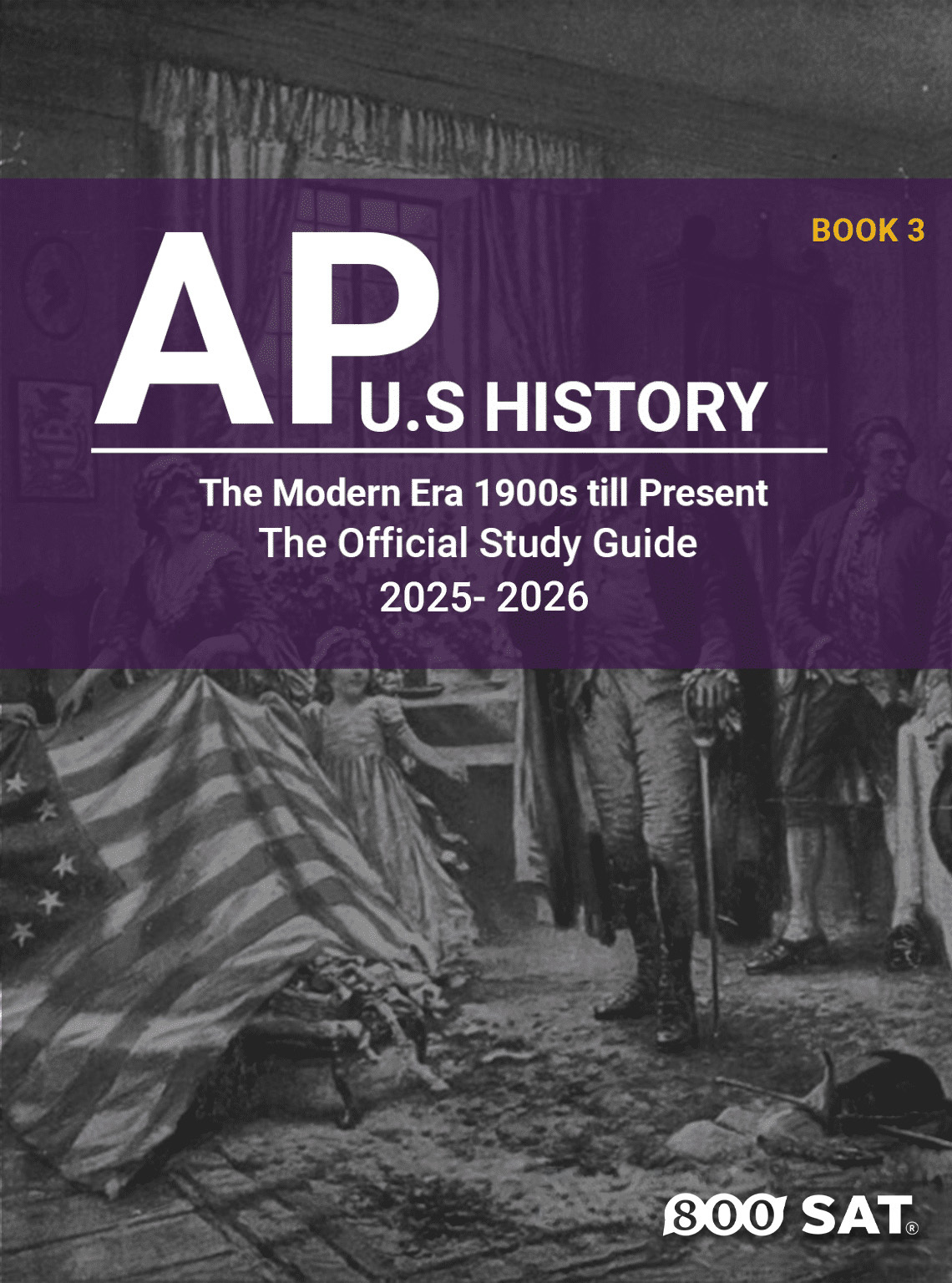
AP U.S History Book 3: The Modern Era 1900s till Present
 AP U.S History Book 3: The Modern Era (1900s–Present)
Explore America’s Transformation in the 20th and 21st Centuries
AP U.S. History Book 3: The Modern Era (1900s–Present) examines the major political, social, economic, and cultural developments that shaped the United States from the 20th century to today. Designed for AP students and history enthusiasts, this book provides a comprehensive guide to understanding modern America.
Early 20th Century Challenges
The book begins with America at the turn of the century, including industrialization, urbanization, and progressive reforms. First, it covers social movements, labor reforms, and economic changes that shaped the nation’s growth. Next, students learn about the United States’ involvement in World War I, the postwar economy, and the cultural shifts of the 1920s.
The Great Depression and World War II
The second section focuses on the economic and political challenges of the 1930s and 1940s. In addition, it explores the causes and consequences of the Great Depression, Franklin D. Roosevelt’s New Deal, and the U.S. role in World War II. Students also examine changes in domestic policy, civil liberties, and global influence during this period.
Postwar Era and Contemporary America
The book then examines the Cold War, civil rights movements, social and political reforms, and economic growth in the postwar period. Furthermore, it addresses contemporary issues including globalization, technological innovation, political polarization, and social change, showing how past events influence today’s society.
Clear and Engaging Content
AP U.S. History Book 3 uses simple language, timelines, diagrams, and real-world examples to make complex historical events easy to understand. Additionally, chapter summaries and review questions reinforce learning and help students prepare effectively for the AP exam.
Whether preparing for the AP exam or studying the evolution of modern America, this book is an essential resource for understanding the nation’s history from the 1900s to the present.
Course Features
- Lectures 16
- Quizzes 3
- Duration 50 hours
- Skill level Intermediate
- Language English
- Students 178
- Assessments Yes
- 3 Sections
- 16 Lessons
- 52 Weeks
- Chapter 1: The Progressive Era and The First World War 1900 - 1920The Progressive Era and World War I defined early 20th-century America, setting the stage for modern reforms and reshaping global dynamics. The Progressive movement laid the groundwork for social justice and government regulation, while the First World War altered global power structures and ideologies, shaping the turbulent century to come.5
- Chapter 2: The Postwar Prosperity, Depression, and Conflict 1920 - 1945The period from 1920 to 1945 was a transformative era in global history, marked by dramatic shifts in economics, politics, and international relations. Emerging from the aftermath of World War I, the world witnessed a brief period of prosperity, followed by the devastating impacts of the Great Depression. This chapter explores how nations navigated these challenges, from the Roaring Twenties to the economic collapse of the 1930s and the subsequent rise of totalitarian regimes leading up to World War II.6
- 2.1“Return to Normalcy” 1920
- 2.2The Roaring 20s: Social Tensions, Immigration, and New Culture
- 2.3Depression and The New Deal 1930s
- 2.4The War of All Wars: World War II 1939 – 1945
- 2.5War in The Pacific and The Post-World Order
- 2.6Assessment 2: The Postwar Prosperity, Depression, and Conflict 1920 – 194520 Minutes10 Questions
- Chapter 3: The Cold War, Civil Rights, and Social Trends 1950 - 2000The second half of the 20th century was a time of profound global transformation, shaped by the ideological rivalry of the Cold War, the struggle for civil rights, and sweeping social changes. This chapter explores how the world was divided between the capitalist West and the communist East, leading to geopolitical tensions and proxy conflicts. It also examines the civil rights movements that challenged racial segregation and discrimination, reshaping societies across the United States and beyond. Additionally, this period saw significant cultural shifts, technological advancements, and the rise of globalization, setting the stage for the modern era.8
- 3.1The Cold War in 1950s: The beginning of the Cold War Truman and Eisenhower
- 3.2Domestic Policies of Truman and Eisenhower During The Cold War
- 3.3The Cold War in 1960s: Kennedy and LBJ
- 3.4Domestic Policies of Kennedy and LBJ During The Cold War
- 3.5Decade of Transition: 1970s
- 3.6Reagan & Bush: Shaping America in the 1980s
- 3.7The 1990s and President Clinton “The Golden Age”
- 3.8Assessment 3: The Cold War, Civil Rights, and Social Trends 1950 – 200030 Minutes10 Questions