
AP Psychology Book 1: Introduction to Psychology 3 Sections17 Lessons12 Quizzes52 Weeks
What is Psychology?
What is Psychology?
Psychology is a systematic and scientific study of mental processes, experiences, and behaviors – both overt and covert. It is derived from two Greek words:
- Psyche: spirit or soul
- Logos: discourse or study
What Does Psychology Study?

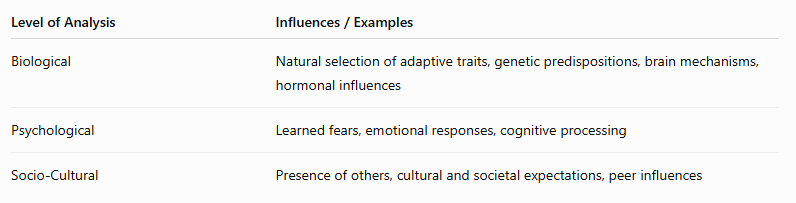
Psychology’s Three Main Levels of Analysis
Of everything you will learn, the most important thing to know about psychology is that it is made up of three very important approaches biopsychosocial approach,


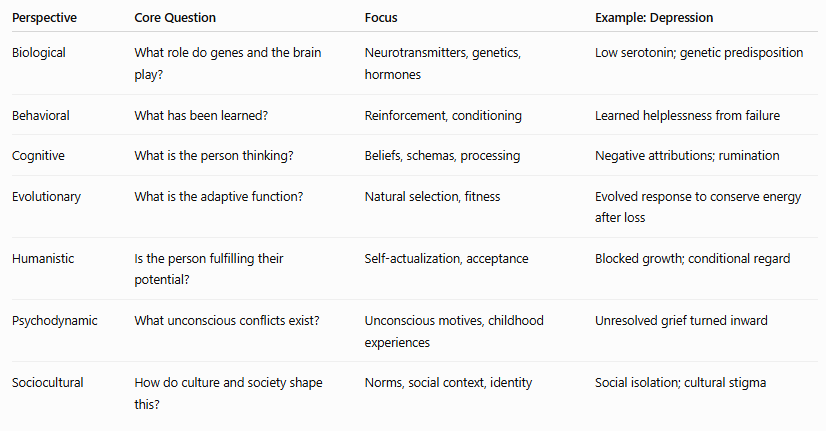
Psychological Perspectives
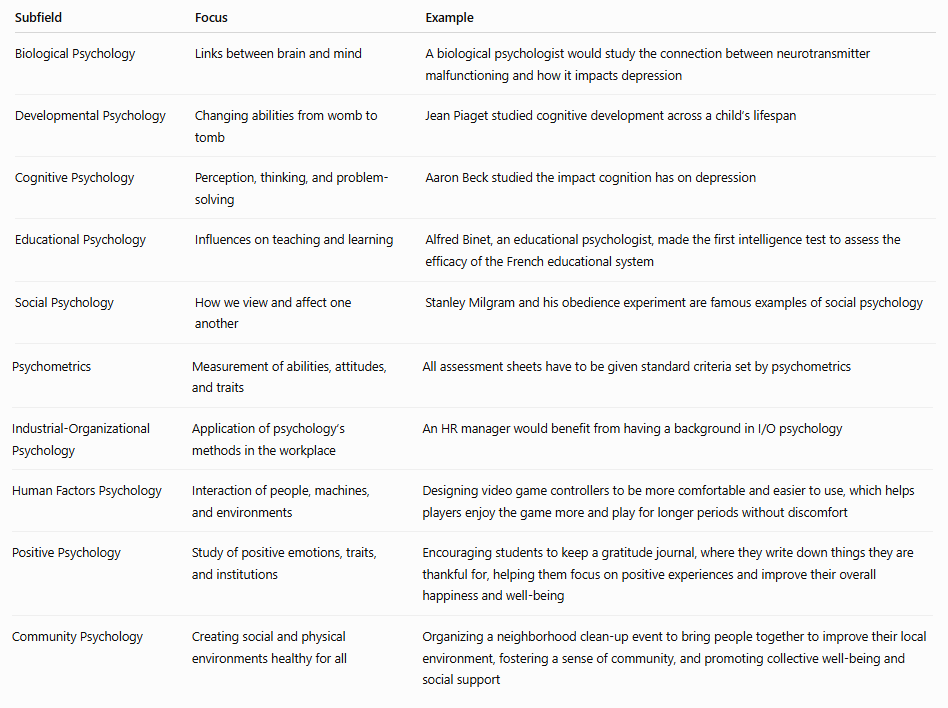
Psychology’s Subfields
Psychology is a cluster of many subfields making it a science. Some psychologists conduct basic research that builds psychology’s knowledge base.
Academic aspect of Psychology aside, there is also a part of Psychology that is devoted to improve aspects of life through:

Let’s take an example.
Sigmund is having a very difficult time at school. He’s performing poorly in class, picking fights, and not focusing when he needs to. So, his concerned teacher sends him to the counselor. The counselor sits him down, talks to him, and tries to figure out how they can help Sigmund. The counselor then realizes that Sigmund might need professional help so they refer them to a Clinical Psychologist – or what we might also know as a therapist. The therapist specializes in Cognitive Behavioral Therapy and tries to do work with Sigmund and assesses him and diagnoses him with depression. Time goes on the therapist finds no matter how much work is done, it isn’t working so the therapist recommends Sigmund goes to a Psychiatrist. The Psychiatrist assesses the situation and asks Sigmund to do a round of blood tests, and once he understands Sigmund’s case he recommends an Anti-Depressant while also continuing the Cognitive Behavioral Therapy.
Nature Vs. Nurture Debate
One of psychology’s oldest questions: How much of who we are comes from our inherited biology (nature) and how much from our environment and experiences (nurture)?
• Nature supporters (historically): emphasized inborn traits and biological inheritance
• Nurture supporters (historically): emphasized experience and environment
• Modern consensus: Nature and nurture always interact. Genes set possibilities; environments activate or suppress them. Everything psychological is simultaneously biological.
Psychology and Critical Thinking
Psychologists are trained to think critically — to question assumptions, demand evidence, and resist the allure of intuition alone. Several common thinking errors are worth knowing:
• Hindsight bias: After learning an outcome, we believe we “knew it all along” — overestimates our ability to predict
• Overconfidence: We tend to be more confident in our beliefs and judgments than the evidence warrants
• Perceiving patterns in random data: Our brains are pattern-seeking; we find meaningful patterns even in noise (e.g., seeing streaks in random coin flips)
• The value of the scientific method: Systematic, replicable, peer-reviewed research is more reliable than personal experience, authority, or intuition alone
Research Ethics
Psychologists who conduct research with human or animal participants are bound by professional ethical standards, overseen by Institutional Review Boards (IRBs). Core principles:
• Informed consent: Participants must be told what they are agreeing to before they agree to it
• Right to withdraw: Participants can leave at any time, without penalty
• Confidentiality: Identifying information is protected; data is reported in aggregate
• Debriefing: Participants are fully informed of the study’s purpose after completion, especially when deception was used
• Protection from harm: Risks must be minimized; potential benefits must outweigh potential harms
• Animal research ethics: Federal guidelines require that animal suffering be minimized and that housing and care standards are met
Important: research findings can be influenced by values
Psychologists’ cultural backgrounds and personal values can subtly influence how they frame research questions, label behaviors, and interpret findings. This is why peer review, replication, and pre-registration of hypotheses are so important — they introduce checks that reduce individual bias. When evaluating any study, ask: Who conducted it? Who funded it? Has it been replicated?